Story
The story of the Osservanza is the story of a community that was able to transform itself and imagine a different future for this great green space.
Foundation of the Complex
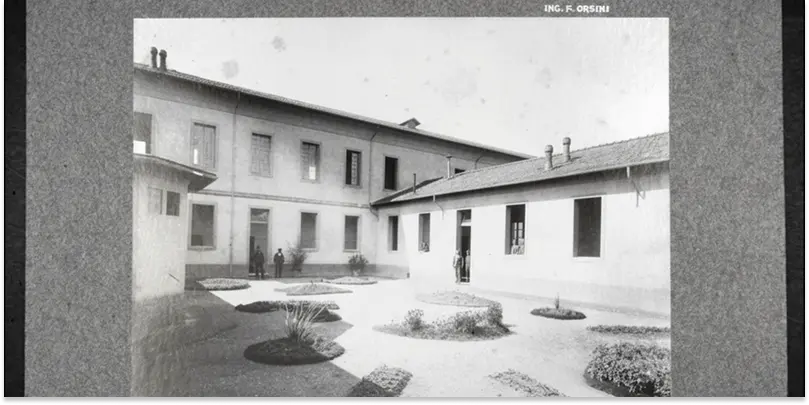
Built between 1890 and 1910, the Osservanza complex was originally a large asylum, part of a system of institutions that for decades shaped the approach to mental illness. Covering 140,000 sqm with six pavilions surrounded by greenery, it was a self-sufficient village that provided employment for thousands of people from Imola.
1 – The Origins: A City Within a City
The story of the Osservanza begins in 1862, when Luigi Lolli took charge of the Imola asylum system. A visionary doctor, Lolli transformed a small facility into an ambitious project: to create a modern care environment inspired by the theories of French physician Philippe Pinel, who at the end of the 18th century had freed the mentally ill from chains, introducing a more humane approach to mental illness.
Between 1869 and 1880, the central asylum “Santa Maria della Scaletta” was established, able to host up to 800 patients. However, demand for admission continued to grow, coming from all over Emilia-Romagna and beyond. New spaces were needed.
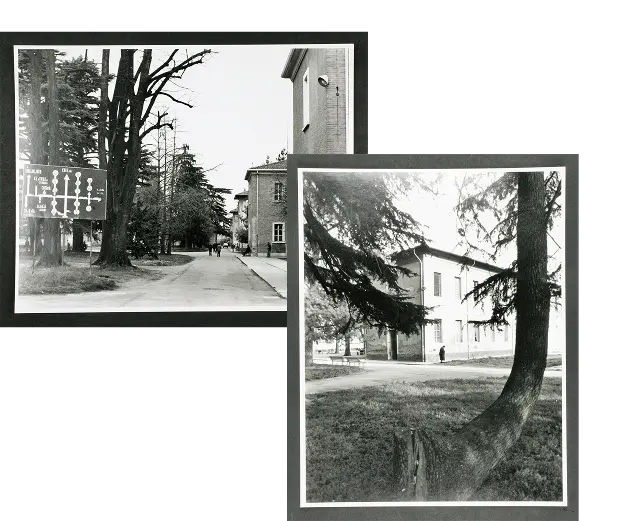
In 1890, Lolli inaugurated the new Osservanza complex. The numbers speak to the scale of the project: 140,000 square meters of space, six main pavilions (three for men, three for women), service buildings, staff residences, artisan workshops, and agricultural areas. An extraordinary green heritage, with over 650 trees that still characterize the landscape today.
At the height of its activity, the Osservanza housed 1,200 patients. It was a truly self-sufficient citadel, providing employment for thousands of people from Imola. It was during these years that Imola earned its reputation—sometimes less than flattering—as the “city of the mad.”
2 - A Century of Light and Shadow
The Osservanza was founded with the ambition of being a place of care. Its spacious gardens, natural light, and work areas reflected the most advanced theories of the time. Yet, over the course of the 20th century, like other Italian asylums, this complex also became a stage for suffering.
Behind its elegant walls unfolded stories of forced confinement, loss of freedom, and exclusion from civil life. Men and women, elderly and children, not always truly ill, often simply “different,” were taken from society and forgotten.
3 - The Basaglia Revolution: “Everyone Out”
On May 13, 1978, Italy passed Law 180, known as the “Basaglia Law” after the psychiatrist who inspired it. It was a revolution: asylums had to close. The mentally ill were no longer seen as dangers to be isolated, but as citizens entitled to care “with respect for the dignity and freedom of the human person.”
Now began the most difficult work: reintegrating into society thousands of people who had known only the institution.
On December 6, 1996, after nearly twenty years of patient preparation, Imola signed the resolution for the permanent closure of its psychiatric hospitals. This was not merely a change of label: the city had created a network of 19 group homes within a 50-kilometer radius, ensuring each former patient a personalized path to reintegration.
“The mentally ill are no longer people to be kept away from society as a danger, but citizens in distress, entitled to care with respect for the dignity and freedom of the human person.”
Osservanza by the Numbers

Total area of the complex

Original Main Pavilions

Number of Patients at Full Capacity

Number of Group Homes Established for Patient Reintegration

Years of Operation of the Psychiatric Hospital (1890–1996)

PNRR Investment for Regeneration